
Bloomy Controls, Inc. - National Instruments Select Alliance Partner
Automated Test, Data Acquisition, and Control Specialists

Automated Test, Data Acquisition, and Control Specialists
Site MapHome


Download Application Brief (PDF)
Download Long Paper (PDF)

Automated Resistance Mapping of LGA Chip Module Contact Grid

Steven Hoenig, Project Manager, Bloomy Controls, USA
Gareth Hougham Ph.D., Research Staff Member, IBM T.J. Watson Research Center, USA

Category: Prototype/Validation Test

Products Used: PXI-4072 DMM, PXI-2503 SWITCH, PXI-2575 SWITCH, LabVIEW 8.5

The Challenge:
Verify uniform force distribution and quality of electrical connectivity on a pressurized Land Grid Array (LGA) interposer. Automate a time-consuming and physically prohibitive process involving substantial measurement, data recording, and data presentation effort.

The Solution:
A LabVIEW and PXI-based measurement system automatically cycles through a set of resistive test points, and takes two- and four-wire resistance measurement. The results are then mapped into an equivalent data structure that recreates the LGA layout, and presents a visually informative 2D and 3D graphical display.

Abstract:
An LGA is a 2D array of physically compliant electrical contacts that enables reversible connections between integrated circuit chip module and printed circuit board (PCB). Connectivity is achieved by pressurizing the LGA in place between the two. Force distribution and other factors that affect electrical performance are verified by measuring each contact's resistance, as contact resistance increases with drops in contact pressure. An LGA can contain contact counts in the thousands, making the process of measuring each contact's resistance followed by mapping and presentation of the entire data set a prohibitively laborious and meticulous effort.

Body:
With the ever growing input/output terminal count and density of integrated circuit chips, the process of connecting chips to PCBs has become very challenging. Replacing a solder-connected chip involves sending the entire board back to the supplier where it must be removed, replaced, and reconnected. Using an LGA as a chip module-to-board interconnect allows the creation of reversible connections that do not require soldering. Rather, LGAs allow field replacement, thus saving considerable time and money for the user. Common applications include high density chip modules found in high performance computers and servers. Field servicing minimizes downtime and costs.

In order to maintain reliable electrical connections and performance, uniform force distribution across the entire LGA is critical. Variations in contact pressure may exist due to contact defects, chip substrate topography, solder mask misalignment, PCB topography, pad contamination and similar factors. To verify an acceptable force distribution, each contact resistance is measured. The effectiveness of an LGA interconnect system can be validated by the statistical spread of the measured resistance data, and in worst cases by the identification of open circuits under certain operating conditions.

Validating an LGA interconnect involves measuring all contact resistances, and visually and numerically analyzing the uniformity. In addition to the physical challenge of taking resistance measurements for numerous contact points residing within an extremely small physical area, the data must be gathered into a meaningful format that facilitates thorough and rapid analysis.

Furthermore, researchers at IBM wish to evaluate resistance distributions at varying external pressures used to hold an LGA in place and at various temperatures that mimick a working computer environment around an LGA. They also wish to evaluate the performance of an LGA over time to verify its sustainability. Validation therefore consists not only of the already difficult process of measuring all the resistances under these different and sometimes dynamically changing conditions (eg. temperature cycling, loss of force to stress relaxation and contact fatigue), but also in creating a data presentation framework that allows tracking of performance between changing conditions.

Clearly an automated means of verification and analysis is required. IBM contracted National Instruments Select Alliance Partner Bloomy Controls to develop an automated system based on PXI modular instruments and LabVIEW software. The PXI system is connected via MXI-4 interface to a PC running an application developed in LabVIEW 8.5.

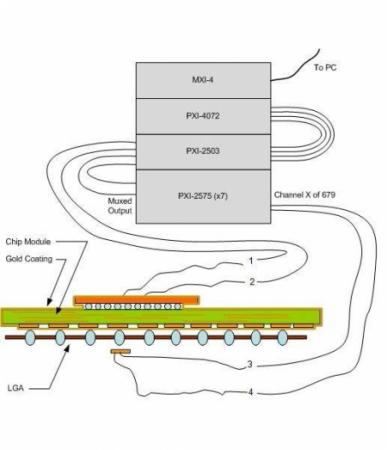
The PXI system is used as a measurement and switch tool for measuring the resistance of all available contact test points on an LGA. 679 sets of test points spread judiciously about the thousands of actual contacts serves as an accurate representation of the true resistance map, while avoiding certain physical constraints involved in measuring every contact. A chip module is modified to act as a shorting block by gold coating conformally around all sides, and pulling two signal wires from this envelope to represent the 'High' side of every contact. Seven PXI-2575 multiplexer modules switch between the pairs of contact test point signals drawn from the other side of the LGA, representing the 'Low' side of each contact. Figure 1 shows a graphical representation of how this connection is made for a single LGA contact.


Figure 1 – PXI measure and switch modules enable LGA resistance mapping for validation and test


The resulting pairs of 'High' and 'Low' signals are fed to a PXI-2503 multiplexer which passes either all 4 signals for a 4-wire resistance measurement or only 2 signals for a 2-wire measurement. These signals are passed to a PXI-4072 digital multimeter (DMM), where the resistance measurement is taken. The 4-wire measurement provides a more accurate measurement in the milliohm range, while the 2-wire measurement more clearly identifies a higher resistance value as an actual open electrical contact.

The LabVIEW software automates the entire measurement process of setting the 2-wire or 4-wire resistance mode via the PXI-2503, cycling through each channel via the PXI-2575, and taking resistance measurements via the PXI-4072. Separate resistance maps are generated for 2-wire and 4-wire resistances, as well as for a combined resistance set where each contact resistance corresponds to the value of the proper measurement type as defined by a user-specified cutoff level.

Resistance maps are all saved to file in multiple formats for later use by this application and offline analysis tools. The data is also presented graphically to the user as a 2D resistance mapping and 3D topography. Several graphical user interface (GUI) tools enable setting graphical image parameters such as color, limits, grayscale, zooming, smoothing, and viewing angle. Either image type can be exported at any time to an image file containing the graphical display as well as key parameters of operation. The graphical tool set can be used to analyze new test data as well as previously tested and stored data.

Figure 2 shows a screenshot of the LabVIEW GUI containing a 3D resistance map in which three open contacts are observed. Figure 3 contains a sample report generated for an LGA with good statistical uniformity. Figure 4 contains a report for a single LGA as evaluated under multiple pressurizations.


Figure 2 - Graphical analysis of 3D resistance map reveals several open pins


Figure 3 - A performance report indicates good statistical uniformity


Figure 4 – A report summarizes an LGA evaluated under multiple pressures. Connections improve with added pressure


The system is expandable to multiple LGA sizes, and includes tools for calibration, data recall, and data analysis and manipulation. The user can also set multiple test runs at predetermined time intervals to allow autonomous testing over time.

LGA resistance mapping of over six hundred contacts is performed in only 5 minutes, whereas the previous method required 20 minutes for four hundred resistance measurements, limited to a single measurement type, plus an additional 30 minutes to prepare the resistance maps off-line. New improvements include integrated analysis and presentation, combined resistance measurement types, and evaluation over changes in time, pressure, and temperature. PXI has provided the ability for wide-range flexible measurements, while LabVIEW provided the platform for implementing an intuitive, scalable, and vital tool for thorough and rapid testing of LGAs, ranging from experimental designs, prototypes, and production units.
Contact Us
Call 860-298-9925 to put our experienced team to work for you.
See case studies
See automation and control systems we've developed for customers.
See case studies
Testimonial
"Bloomy Controls provided rapid software development assistance for our test application. I recommend them to anyone interested in optimizing their systems integration."

Jonathan W. Schrumm
President
Northeastern Fire Associates Inc.
Read More
ENGINEERINGTRAININGEVENTSRESOURCESABOUTSITE MAPHOMEPRIVACY POLICY
Headquarters:
Bloomy Controls, Inc.
839 Marshall Phelps Rd.
Windsor, CT 06095-2170
Phone: 860-298-9925
Fax: 860-298-9535
Email Us
Field offices:
257 Simarano Drive
Marlborough, MA 01752
Phone: 508-281-8288
Fax: 508-281-8295

39-40 Broadway
Fair Lawn, NJ 07410
Phone: 201-773-9115
Fax: 201-773-9117

© 2012 Bloomy Controls, Inc. All rights reserved. Product and company names are trademarks or trade names of their respective companies.

Web development by Crucial Networking Web development
by Crucial Networking


Resources See case studies