

Customer
U.S. Army (DEVCOM-SC)
Challenge
Monitor and analyze the power consumption of multiple Soldier-borne electronics during simulation and field exercises. Understand how Soldiers consume power in order to optimize the tradeoff between the energy and the weight of the batteries and inform Army leadership on mission power posture.
Solution
The BLOOMY® eSoldier Power Monitoring System, a self-contained system comprised of a miniature, field power acquisition unit, wired and wireless sensors, and a remote computer running power analysis software. The system is high performance, sampling 24 channels of voltages, currents and other sensors at configurable ranges and rates up to 100k samples per second per channel. The system is lightweight, rugged, battery powered, and miniaturized so that it can be worn by a soldier to track all energy consumption. Moreover, this system can be easily expanded to utilize additional sensor types for increased measurement capabilities.
Abstract
As battlefield technology advances, US Army Soldiers carry more electronic capabilities than ever before. The Development Command Soldier Center (DEVCOM-SC) evaluates the feasibility and efficiency of Soldier-borne electronics using an innovative system from Bloomy Controls, Inc. (BLOOMY®) that Soldiers wear during laboratory and field exercises to monitor and analyze the current, voltage and power consumption of Soldier-borne electronics. DEVCOM-SC chose BLOOMY among multiple vendors to provide the system because of the company’s ability to design and manufacture high-performance automated test and measurement systems with high fidelity, reliability, and quality. This article summarizes the power monitoring system’s hardware, software, performance, and benefits since deployment by DEVCOM-SC.
System Description
The system consists of multiple power sensor nodes, a miniature power acquisition unit (PAU), and a remote computer running the Soldier Power Analysis Software, as shown in Figure 1. These components work together to acquire, record, analyze and display the power data.
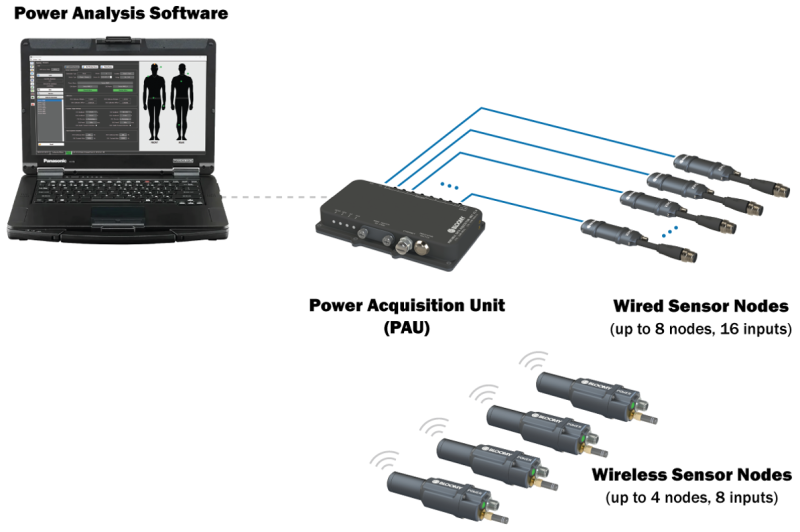
Each power sensor node measures the voltage and current from one Soldier-borne electronic device. The system contains up to eight wired and up to four wireless sensor nodes, which together can acquire power measurements on up to 12 different devices. The sensor nodes are lightweight and have configurable measurement range, acquisition speed, and transient detection threshold. When worn wirelessly, the sensor nodes communicate via Bluetooth to the field power acquisition unit.
The compact power acquisition unit (PAU) is 6.9” x 4.5” x 1.1” and weighs only 1 pound. The unit has two modes of operation: direct (cable) and remote. In direct mode, acquired data is stored in real time on the remote computer. In remote mode, the data is stored on an SD card directly on the power acquisition unit. The unit acquires power data from all sensor nodes, performs onboard processing, and stores the data according to the mode of operation. The unit contains a National Instruments (NI) CompactRIO System on Module (SOM), BLOOMY custom analog input and Bluetooth communications modules, and a rechargeable battery. The NI SOM is a small, flexible, embedded computer that combines an ARM processor, the NI Linux Real-Time Operating System running LabVIEW software, and a programmable Xilinx FPGA. The sampling and transient detection of hardwired sensor nodes is performed on the FPGA, while the buffering, communications, and data logging algorithms are performed on the ARM processor. The NI SOM was chosen because of the high-speed, deterministic performance and the maintainability of LabVIEW software. Specifically, the NI SOM provides the processing power to capture transients and peak data as fast as 10 microseconds.
The power acquisition unit acquires data from up to 16 wired and 8 wireless sensor nodes, each sampled at independently-configurable rates up to 100k samples per second. The wireless sensor nodes also provide transient detection algorithms at rates up to 100k samples per second per channel. The field power acquisition unit also includes an integrated GPS receiver, providing synchronized recording of location data. The system connects to the remote computer through an Ethernet connection. Powered by a rechargeable conformal wearable battery (CWB), the unit can operate for 29 hours on a single charge. The overall system conforms to MIL-STD-810, MIL-STD-461, and IP67.
eSoldier Power Analysis Software
The remote computer is a Windows laptop PC running the Power Analysis Software which BLOOMY developed using NI LabVIEW. The software configures the sensor nodes and wireless network and provides an intuitive real-time graphical display. Each power sensor node is configured for specific voltage and current ranges, as well as continuous and transient sampling rates.
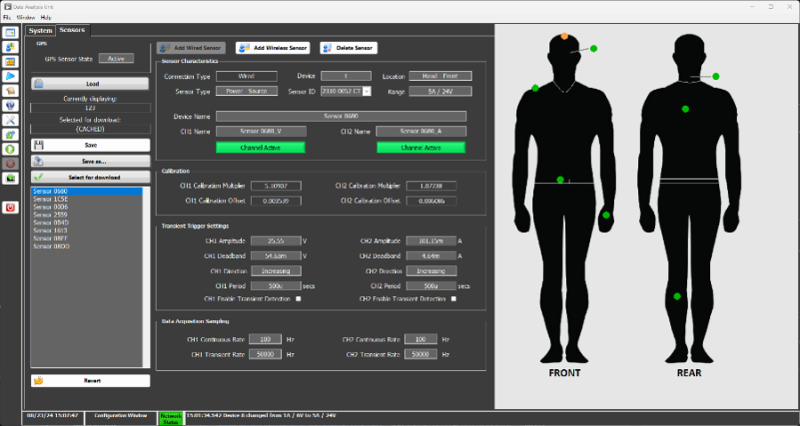
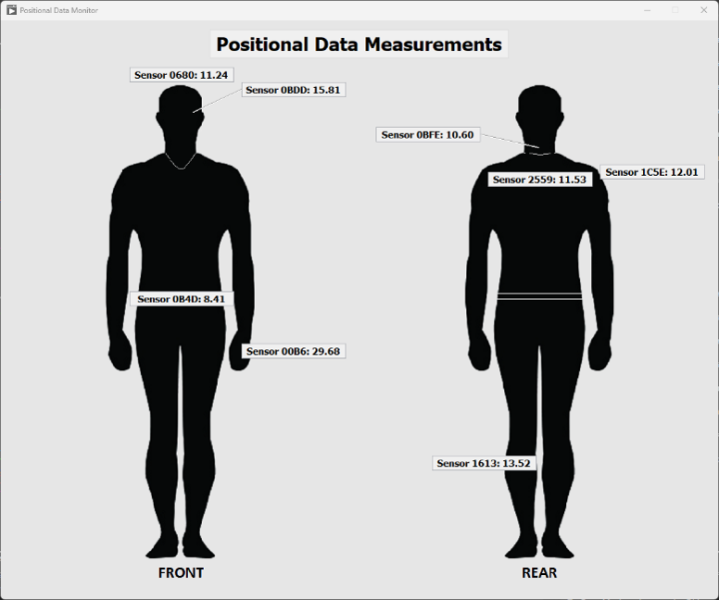
As shown in Figure 2, a model of the Soldier is displayed on the graphical user interface indicating the location of each electronic device on the Soldier’s body as well as live display of the corresponding power measurements. The software can also play back historical data in real time, in synchronization with the simulation exercise that the Soldier performs. The Power Analysis Software also contains an events log, which records all system activity and diagnostics. High speed transient data is organized in separate files using the TDMS format, which is easily viewed using NI LabVIEW and DIAdem.
Use Cases
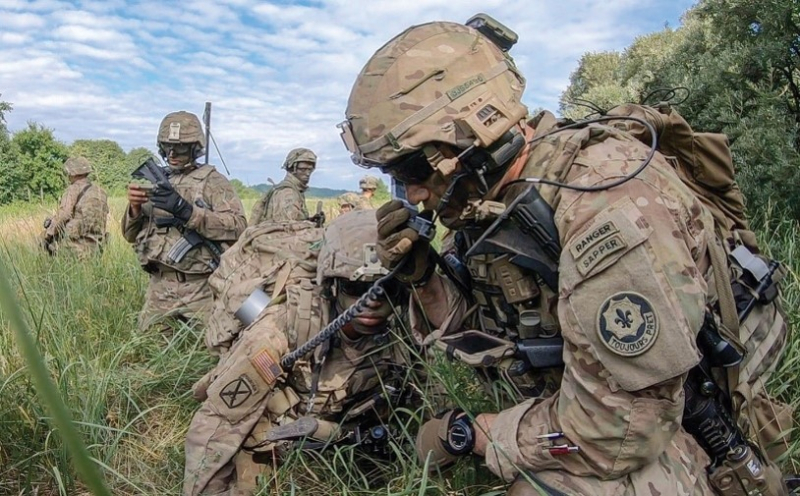
The system has been used in several laboratory and field evaluations: Nett Warrior and subcomponents, Integrated Visual Augmentation System (IVAS), exoskeleton, energy harvesting on the Soldier, micro-climate cooling, and battery evaluations. These evaluations have taken place at the US Army’s Maneuver Center of Excellence in Fort Moore, GA; Fort Liberty, NC; Camp Pendleton, CA (USMC); and DEVCOM-SC engineering headquarters in Natick, MA.
Conclusion
The BLOOMY eSoldier Power Monitoring System provides DEVCOM-SC and other military organizations, as well as commercial and defense contractors, with a high-performance, low-noise system that is low power, light weight, reliable, and configurable. The custom analog input and wireless sensor nodes, coupled with NI SOM, allows this system to acquire up to 24 sensors channels with sampling rates up to 100K samples per second per channel. The Power Analysis software, developed by BLOOMY using NI LabVIEW, remotely controls the system and provides an intuitive graphical user interface. The physical and electrical specifications of the overall system meet the unique requirements of US Army DEVCOM-SC. The system has allowed DEVCOM-SC to inform Army leadership on the energy use at the Soldier level, a capability which did not previously exist.
“The eSoldier Power Monitoring System is a government-developed system which has allowed DEVCOM-SC to acquire data in ways that were not feasible or possible before. DEVCOM-SC plans to use the system for the foreseeable future and develop further capabilities with it.” Noel Soto, US Army (DEVCOM-SC), Natick, MA
PAO/OPSEC Approval Number: PR2024-1861
Author Biographies
Peter Blume is the President and Founder of BLOOMY®, a leading provider of automated test solutions for mission-critical and emerging applications. Peter is the author of The LabVIEW Style Book (Prentice Hall, © 2007), the industry standard for LabVIEW development style. Peter is an electrical and computer engineering graduate of the University of Connecticut, and inductee of UCONN’s Academy of Distinguished Engineers.
Noel Soto is Systems Engineer, Program Integrator & Mission Planner for U.S. Army DEVCOM Soldier Center. Noel has a BS EE degree from UMASS Lowell, and 20+ years of electronic and quality systems experience. Noel is the technical lead for eSoldier.
Related Links
eSoldier Power Monitoring System
Army DEVCOM-SC: www.devcom.army.mil